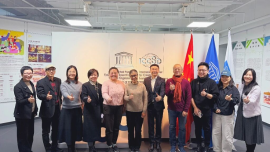
On January 21, 2026, the briefing session for the 2025 Call for Cases on Protecting and Promoting the Diversity of Cultural Expressions in the Digital Environment, along with an outreach activity of the Culture and Technology Innovation Service Alliance, was held at the South Central Axis xR Cloud Performing Arts Center in Beijing.
The event was guided by the International Centre for Creativity and Sustainable Development under the auspices of UNESCO (ICCSD); jointly organized by the Zhongguancun Zhongheng Culture Technology Innovation Service Alliance; the Institute for Cultural Creativity, Tsinghua University; and the Professional Committee of Cultural Creativity of Tsinghua Alumni Association; and co-organized by Yunxi (Beijing) Cultural Technology Co., Ltd. Experts and industry representatives from universities, research institutions, cultural technology enterprises, and professional organizations gathered to engage in in-depth discussions on topics including the role of digital technologies in safeguarding cultural diversity and innovative transformation of cultural heritage.

Ms. Chen Jie, representative of the ICCSD, provided a comprehensive interpretation of the strategic background and global significance of the "2025 Global Digital Innovation Case Collection" from the perspective of global governance. She noted that as the Convention on the Protection and Promotion of the Diversity of Cultural Expressions approaches its 20th anniversary, the case collection initiative has been formally incorporated into UNESCO's global celebratory agenda. Its evaluation criteria go beyond showcasing individual technologies, placing greater emphasis on international responsibility and people-centered values.
Chen emphasized that the initiative seeks to identify Chinese practices that are genuinely replicable and development-oriented—specifically, low-cost, standardized models that can be adapted across regions and scales, particularly in developing countries, while also aligning with the United Nations Sustainable Development Goals, including decent work and gender equality.
ICCSD will focus on three key areas: technology-enabled development of cultural industries, protection of cultural heritage, and living transmission and community-based innovation of intangible cultural heritage. These efforts aim to support Chinese digital cultural and creative enterprises in going global with a strong sense of social responsibility, promoting a transition from technology application to standard-setting and value leadership on the international stage.

At the beginning of the event, Liu Bing, Secretary-General of the Culture and Technology Innovation Service Alliance, delivered a speech. He emphasized that, in the context of rapidly evolving digital technologies, the integration of culture and technology has become a key driver for promoting high-quality cultural development. The Alliance will continue to leverage its role as a platform and connector, linking resources from universities, research institutions, and enterprises to steadily align outstanding achievements with practical applications. This collaborative approach aims to deepen the integration of culture and technology, and to enable exemplary cultural and technological outcomes to be shared and applied on a broader international stage.

Zhang Zheng, Vice Dean of the School of Journalism and Communication; Vice Dean and Professor at the Institute for Cultural Creativity, Tsinghua University; and President of the Professional Committee of Cultural Creativity of Tsinghua Alumni Association, highlighted that while algorithms and generative artificial intelligence can enhance creative efficiency, they may also exacerbate homogenization of expression and digital forgetting. He stressed that the use of technology should be guided by the principle of technology for good, with improved mechanisms for dissemination and preservation, ensuring that cultural diversity is visible, inheritable, and sustainably developed in digital spaces.

During the thematic sharing session, several experts and scholars from universities and research institutions engaged in discussions on cutting-edge technologies and international practices, drawing on their respective research and practical experience to explore diverse pathways for advancing cultural development in the digital environment.
Du Fanding, Chief Planner of the Heritage Protection & Adaptive Reuse Branch of Tsinghua Tongheng Urban Planning & Design Institute, presented digital practices related to heritage-themed cultural routes. He introduced the application of technologies such as AI-based monitoring and micro-trace imaging in the conservation and presentation of grotto heritage, demonstrating the potential of digital approaches to reduce conservation costs while enhancing public engagement and visitor experience.

An Nanxu, a representative of the Communication and Education Center of the Cultural Heritage Conservation Center of Qingyuan shared insights drawn from World Heritage conservation practices. He highlighted how digital tools can be used to construct a holistic understanding of heritage values, emphasizing that data integration and systematic presentation help deepen heritage interpretation and public understanding. He also stressed the importance of promoting synergy between public communication and governance, thereby strengthening the coherence and effectiveness of heritage awareness and dissemination.

From the perspective of creative communication, Zhang Lie, Professor at the Academy of Arts & Design, Tsinghua University, explored how digital art and interactive design can bring cultural heritage closer to the public in a more vivid and immersive manner. Through striking case studies such as the Yingtianmen Site Museum in Luoyang and the digital art exhibition of the Kizil Cave murals, he demonstrated how innovative digital expressions can transform heritage presentation and audience experience.

Wang Xia, Representative of the Science and Art Center of the Institute of Automation, Chinese Academy of Sciences, introduced concepts related to the Ocean Metaverse, outlining the application prospects of digital technologies in the dissemination of marine culture and ecological civilization. She emphasized that presenting ocean-related cultural and ecological themes through digital means can expand modes of communication and public participation, while promoting cross-disciplinary collaboration between science and art.

International digital artist Song Ting shared practical experience in empowering youth cultural expression in Belt and Road countries through artificial intelligence, drawing on a generative AI art hackathon for Lao youth as a case study. She highlighted that generative AI can stimulate young people's capacity to express local culture in educational and creative settings, enabling creators from different regions to enter digital creation with lower barriers and greater accessibility.

De Wen, Founder of Innomix, presented exploratory applications of spatial computing technologies in immersive cultural heritage experiences. He noted that, when combined with specialized hardware, spatial computing can enhance on-site immersion and the integration of physical and virtual environments, improving audiences' perception of heritage spaces and details, and offering new technological pathways for heritage presentation and dissemination.

Focusing on regional cooperation, Liu Changyuan, Project Lead of the Lancang-Mekong Cross-border Language AI Large Model, introduced the potential of multilingual artificial intelligence technologies in facilitating cross-cultural communication and regional collaboration. He emphasized that language models can reduce cross-language communication costs, support the flow of information across cultures, and enable cooperation across a wider range of communication scenarios.

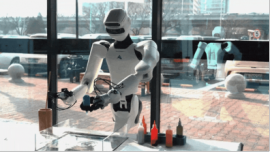
During the event, participants also toured and exchanged views on the digital performance and virtual production infrastructure of the venue. Representatives from Yunxi (Beijing) Cultural Technology Co., Ltd. introduced practical applications of their technology platforms in cloud-based performances, virtual production, and digital content dissemination, providing strong technical support for the integration of culture and technology.

Through a combination of policy interpretation, case sharing, and practical exchange, the event showcased multiple pathways for leveraging digital technologies to protect and promote cultural diversity and innovative development. Participants widely agreed that, amid the accelerating global digital transformation, it is essential to strengthen collaboration among universities, research institutions, and industry, and to advance Chinese cultural-technology practices toward more influential, internationally resonant China-proposed solutions.